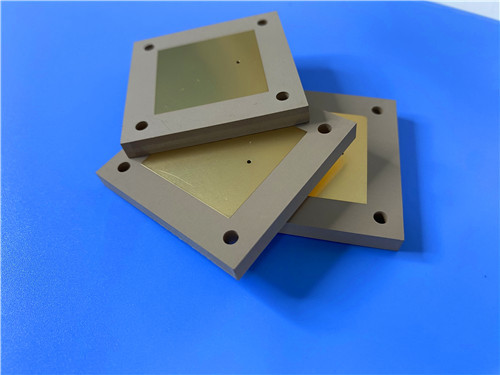
Hi, I'm Sally. Today I'm showcasing a custom PCB built on Rogers TMM10—a thermoset microwave material with a high dielectric constant of 9.20 and an unusually thick 5.08mm core.
This custom PCB was fabricated using Rogers TMM10, a ceramic-filled thermoset microwave material with a dielectric constant of 9.20 at 10 GHz. An unusually thick 5.08mm (200mil) core was specified, enabling a finished board thickness of 5.1mm. The high Dk supports compact circuit geometries, making this design well-suited for satellite communications, GPS antennas, and chip testers.
Key Takeaways
- Material: Rogers TMM10 — ceramic-filled thermoset microwave material (Dk 9.20)
- Key Benefit: High Dk for circuit miniaturization, thermoset stability, thick core option
- Board Size: 63.9mm x 48mm | Finished Thickness: 5.1mm
- Construction: Double-sided, no solder mask was applied on either side, no silkscreen was used
- Design: 26 components, 13 vias, 2 nets — a focused RF circuit
- Quality: IPC-Class-2 was met, and 100% electrical testing was performed
The Challenge: A High-Dk Design with Exceptional Thickness
An RF board was required by our customer that combined a high dielectric constant with an unusually thick substrate. The 5.08mm core was needed to achieve specific mechanical or electrical objectives—whether for mechanical rigidity, specific impedance characteristics, or antenna performance. Standard thin laminates could not meet these requirements.
TMM10 was selected, a thermoset microwave material that combines the benefits of PTFE and ceramic substrates. Here's why it was chosen:
High Dielectric Constant (Dk = 9.20 ± 0.230 at 10 GHz)
Compact circuit geometries were enabled by the high Dk—a significant advantage for space-constrained RF designs.
Low Loss (Df = 0.0022 at 10 GHz)
Minimal signal attenuation was ensured, critical for sensitive RF and microwave circuits.
Thick Core Availability (5.08mm / 200mil)
An unusually thick core was specified and delivered. TMM10 is available in thicknesses ranging from 0.0015 to 0.500 inches, providing exceptional design flexibility.
Thermoset Stability
Resistance to creep and cold flow was provided—unlike PTFE materials. Dimensional stability was maintained over time, and the CTE was matched to copper (21 ppm/K in X/Y axes) for reliable plated through-holes.
Processing Advantages
Sodium napthanate treatment was not required prior to electroless plating, simplifying manufacturing. The material is also resistant to process chemicals.
Reliable Wire-Bonding
The thermoset resin allows for reliable wire-bonding, a valuable capability for chip testers and specialized RF assemblies.
Board Specifications
| Feature |
Specification |
| Dimensions |
63.9mm x 48mm (±0.15mm) |
| Stackup |
35μm Cu / 5.08mm TMM10 / 35μm Cu |
| Finished Thickness |
5.1mm |
| Trace/Space |
4/7 mils |
| Min Hole Size |
0.25mm |
| Surface Finish |
ENIG |
| Solder Mask |
None (both sides) |
| Silkscreen |
None |
| Testing |
100% electrical |
| Standard |
IPC-Class-2 |
| Design Statistics |
|
| Metric |
Value |
| Components |
26 |
| Total Pads |
38 (21 through-hole, 17 SMT) |
| Vias |
13 |
| Nets |
2 |
The 2-net design indicates a focused RF sub-circuit—likely a filter, coupler, or antenna feed network. The 5.1mm finished thickness is highly unusual for a 2-layer board and suggests specific mechanical or electrical requirements.
Material Properties: The Numbers Behind TMM10
| Property |
Value |
| Dk @ 10 GHz |
9.20 ± 0.230 |
| Df @ 10 GHz |
0.0022 |
| TCDk |
-38 ppm/°K |
| CTE (X/Y/Z) |
21/21/20 ppm/K |
| Thermal Conductivity |
0.76 W/mK |
| Decomposition Temperature |
425°C (TGA) |
| Thickness Range |
0.0015–0.500 inches |
TMM10 offers a high Dk in a thermoset material, enabling both circuit miniaturization and mechanical stability. The wide thickness range—including the 5.08mm core used here—provides exceptional design flexibility.
TMM10 and TMM10i are closely related, with TMM10i offering a slightly higher Dk. Both provide thermoset stability and are available in thick cores.
Ideal Applications
- Chip testers requiring reliable wire-bonding and consistent performance
- Dielectric polarizers benefiting from high Dk and thick substrates
- Satellite communication systems where compact, reliable RF circuits are essential
- GPS antennas and patch antennas requiring precise impedance control
Q: Why was such a thick core (5.08mm) specified?
A: The thick core may have been specified for mechanical rigidity, specific impedance characteristics, or antenna performance. TMM10 is available in thicknesses up to 0.500 inches, providing exceptional design flexibility.
Q: What makes TMM10 different from PTFE materials?
A: TMM10 is a thermoset material, so it resists creep and cold flow—unlike PTFE. It also doesn't require sodium napthanate treatment before plating, simplifying manufacturing.
Q: Why was no solder mask or silkscreen applied?
A: Both were eliminated to prevent any potential dielectric loss or interference with RF performance—critical for sensitive microwave circuits.
Q: What's the significance of the 2-net design?
A: A 2-net design indicates a focused RF sub-circuit, such as a filter, coupler, or antenna feed network.
Q: Is TMM10 suitable for wire-bonding?
A: Yes. The thermoset resin allows for reliable wire-bonding, making it valuable for chip testers and specialized RF assemblies.
Q: How does TMM10 handle high temperatures?
A: A decomposition temperature of 425°C (TGA) is withstood, and the CTE is matched to copper for reliable plated through-holes through thermal cycling.
Final Thoughts
Rogers TMM10 delivers high Dk, low loss, and thermoset stability in a material that can be specified in unusually thick cores. When your RF design requires both compact geometries and mechanical robustness, this material delivers.
Got a high-Dk or thick-substrate project in mind? I'd love to hear about it.


 Ваше сообщение должно содержать от 20 до 3000 символов!